

System for automatic monitoring of technological parameters of wastewater treatment at Nasha Ryaba PJSC wastewater treatment facilities“
- Objective: PJSC Nasha Ryaba.
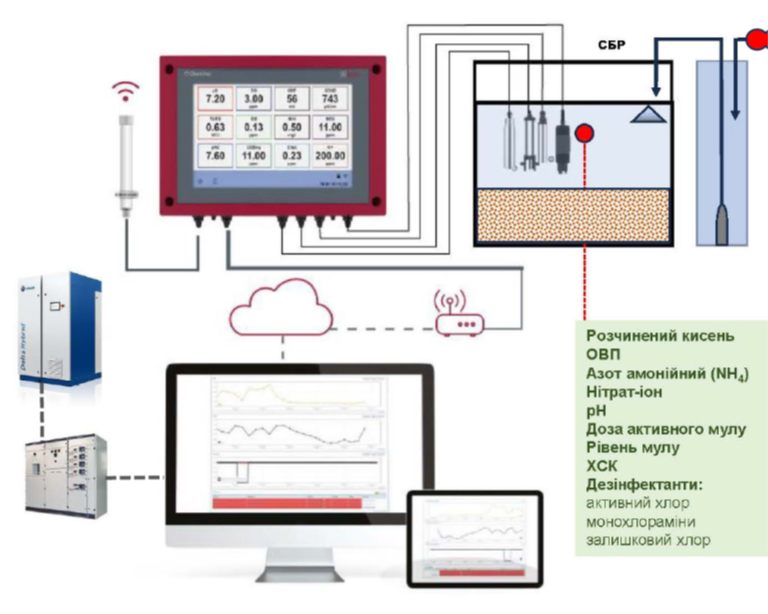
- Automatic monitoring system technological parameters of wastewater treatment of SBR 2
- Construction volume 12500 м3
The initial data of the object
- Process monitoring by dissolved oxygen concentration only
- Current hydraulic loads reach 8500 m3/day
- 2 SRBs with a capacity of up to 12500 m3 each are in operation
Problems before the reconstruction
- There is no system of online monitoring of key parameters
- Increased hydraulic and process loads on the BWR compared to the design
- The current management model does not take into account a number of technological parameters
Technical solutions adopted
Applied monitoring parameters
- Ammonium
- Nitrates
- Oxygen
- pH/ODP
- Free chlorine, residual chlorine and ammonium chloride
Results achieved
The project of an online monitoring system for the main indicators of the nitri-denitrification process was implemented:
- Increased aeration system capacity and improved technological performance of industrial wastewater treatment.
- Improved operating conditions of the system - no need for constant repairs of the aeration system
- Convenient access to the aeration system elements is provided by means of bridges
- Increased stability of aerobic reactors within the limits of the MPC for discharge of treated wastewater into a water body
- The online monitoring system for the main indicators of the nitri-denitrification process provides personnel with the necessary information on the process in the reactors to make operational decisions
- Reduced electricity consumption per 1 m3 of wastewater
Why automatic control of the accepted parameters is important
| Indicator. | Description. |
|---|---|
| Ammonium ion | The initial substrate for nitrification. Nitrifying bacteria (Nitrosomonas, Nitrobacter) oxidize ammonium first to nitrite (NO₂-) and then to nitrate (NO₃-). The balance is important: excess ammonium can lead to toxicity and inhibition of processes, while a deficit can lead to a lack of substrate for nitrification. |
| Nitrate ion | The main electron acceptor in denitrification. Anaerobic bacteria (Pseudomonas, Paracoccus) reduce nitrate to gaseous forms of nitrogen (N₂, N₂O). Key performance indicator: the presence of nitrate indicates successful nitrification, and its decrease indicates active denitrification. |
| pH / ORP | The ORP control allows the operator to control the process phases - when the system should operate for ammonium oxidation and when for nitrate reduction. |
| Chlorine derivatives | Chlorine derivatives destroy cell membranes and enzyme systems. This leads to a decrease in the rate of oxidation of organic and nitrogen compounds. As a result, the purification efficiency decreases and the load on the subsequent stages increases. Identification of the causes of biocenosis degradation. The concentration of disinfectants, which are a component of many detergents, is critical for maintaining the physiological state of the biocenosis. If the limit concentrations are exceeded and sludge degradation occurs, the reactor may malfunction for a long time. It is possible to control the parameters containing chlorine ions: active chlorine, residual chlorine, monochloramines - compounds formed in the presence of ammonium ions and active chlorine in water. |
Work efficiency
| Parameter | Before treatment (mg/l, before) | After cleaning (mg/l, before) |
|---|---|---|
| COD | 1740 | 58 |
| Ammonium nitrogen | 130 | 0,60 |
| Suspended solids | 350 | 12 |


Send your task